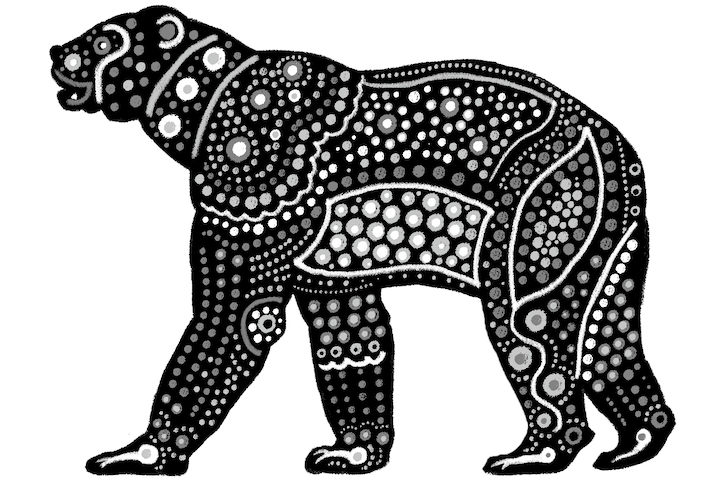
My name is Ushesh. In my earthly life I inhabited the far northwest corner of North America, at a time when the glaciers were receding and the first of you humans were entering our world. My snout was shorter and my face flatter and wider than the bears you are now familiar with, and I was much bigger than any bear now living on Earth. When standing on all fours I was taller than most humans; when standing upright on my hind legs I reached eleven feet in height. My species was intensely carnivorous, but as you will learn I was very averse to the predatory life, and always felt that the gods miscast me as a ferocious bear.
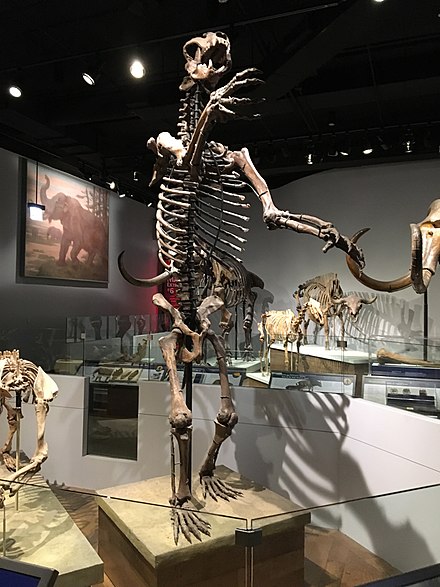
My kind once lived throughout North America, from the Pacific Ocean all the way to the Atlantic, from the far north all the way down to the mountains of Mexico. The forests of the far northwest were very different then, full of strange and wonderful animals that no longer exist—woolly mammoths and mastodons, big wolves, lions and cats, giant ground sloths twice as tall as myself, huge beavers, horses, camels, and many more. As you know all these large animals died out soon after you humans arrived into our world.
Strange as it may sound, most animals had no fear of your kind when you first arrived on our continent. We had evolved together without humans for millions of years, and knew friend and foe from long experience. That is Nature’s way—relationships are established over long periods of time. For most of us it was as though a new type of bird had suddenly come to visit—we were curious at first, but not afraid. What did a giant mammoth or bear have to fear from these tiny intruders who walked upon only two legs?
None of us had any knowledge of your species, but we gradually learned that we were no match for your weapons and your cunning. The biggest and slowest moving animals—the ground sloths, the mammoths, the giant beavers—could not hope to escape a surprise attack by a band of humans. We animals needed to be close to our attackers in order to defend ourselves, but you humans took that advantage away from us. You could inflict mortal wounds from a distance with your spears and slingshots. As the largest creatures reproduced very slowly, they could not replace themselves as fast as they were being killed.
My first contact with your species came early in my life. Shortly after my mother and I separated she had a dark premonition that great danger was present on the other side of the glacier. She caught an unfamiliar scent coming from the east that filled her with terrible fear, so later that summer, after I had adjusted to our separation, she came to me and asked if I could travel across the glacier to investigate. As a cub I had always dreamed of one day traveling to the far side of the glacier, and always imagined that wonderful creatures must live there, but I had never seen my mother so unsettled. She told me to be very careful.
So I set off on my mission, and soon discovered that the east side of the glacier was populated by the same animals as my home world. This made me feel rather sad, but I continued following a river flowing to the southeast. For three days I saw nothing unusual, but then during the fourth night I climbed to the top of a low hillside and saw a small fire far off in the distance. I watched for a short while, and saw that the fire was not becoming bigger or changing its position in any way; the weather had been clear, with no storms or lightning, so I felt puzzled and decided to investigate. As I grew closer I began to smell smoke from the fire, and then another scent that made me understand my mother’s fear.
I was so disturbed by this unfamiliar smell that I wanted to run away, but I followed it and soon arrived at the edge of a forest. I peered through the trees and saw them—about twenty humans in a large clearing. They made strange noises and carried strange odors beyond what I smelled in the smoke. They had no fur of their own, but seemed to be adorned with the fur of other animals, and I saw that they were roasting animal flesh over the fire, which frightened me most of all.
I followed these humans for four more days. At night I saw them create fires seemingly out of thin air, as if by magic, while during the day I watched them hunting animals by throwing their pointed sticks. On the fourth day I saw them kill a large lioness—of the kind with the long, curved teeth—who had come to the river to drink. I had finally found the fantastical creatures of my cubbish imagination, yet I felt more anxiety than excitement. After seeing these things I headed home as fast as I could. I found my mother at her favorite spot near our lake and told her everything I had observed; she named these new animals the Aathsha—the furless danger creatures.
That summer was the last in which we lived free of the Aathsha. The following year they came across the glacier to our home. They hunted mostly deer and elk at first, and I sometimes tried to scavenge what was left of their meals. For a time lions, wolves, and my kind would sometimes scare the Aathsha away from their kills, but it did not take them long to adjust. Their spears became bigger and they became much more aggressive in defending their carcasses.
The Aathsha also began hunting and successfully killing much larger prey. Once I saw them attack one of my own kind, but this bear fought back ferociously and killed two of its attackers. I wondered why they had risked attacking such large and dangerous prey.
Every year more Aathsha arrived in our world, most continuing southward without stopping for long. In my eighteenth year of life, they finally came for me. I was resting in a small, open cave high on a hillside, a spot my mother and I had often come to when I was a cub. I had used this cave for many years, and had never seen the Aathsha travel this high up the hill.
It was a brilliant, warm summer afternoon, and I had been dozing peacefully for many hours, listening to the birds and the chattering squirrels, reveling in the scent of the spruce trees that was carried up the hillside by the breeze. Now, squirrels are nervous creatures, so much of their chatter is existential anxiety. I could not decide if they were issuing a real warning or merely ruminating, and I was feeling so relaxed and comfortable that I did not get up to check; my old bones were not as nimble and quick as they had once been. Well, all in one moment I finally caught the scent of the Aathsha and heard their movements very close to my cave. I got up and charged outside, straight into a barrage of rocks and spears. I saw a large rock strike me squarely in the forehead, and became so dizzy that I quickly collapsed. They made short work of me after that.
As I felt my body being bludgeoned and stabbed, all I could think was … ‘If only I had gotten up sooner … If only I had run to the left instead of the right, I might have escaped.’ But my mind rapidly let go of these trivial obsessions and I surrendered, more peacefully than I could ever have imagined, to the reality of death. My consciousness of my surroundings, of my body and the tremendous pain it was feeling, quickly faded. I no longer smelled the spruce forest or heard the queer murmurings of the Aathsha voices. I found myself in a state of complete tranquility, unconcerned with the clumsy and undignified death I had just suffered. I had returned to the unconscious dreamtime.
Death was not the final, absolute oblivion I had always feared. It was a homecoming, a glorious return to a state of remembrance and understanding. The escape and death of memory may be earthly life’s greatest sorrow. To forget all the details and nuances of a vivid dream or an experience from early in one’s life, to have that feeling of something vital dissolving irretrievably into oblivion … Can there be any greater sadness than this?
In death I realized the impossibility of all unconscious memory and knowledge being confined to a material body—I saw the tremendous emptying that must occur to inhabit a corporeal form. As the stomach can hold only so much food, so too the body—whether bear, bird, or human—can contain only so much knowledge, memory, and spiritual energy. I understood that every living creature carries the vague knowledge of all that is missing, and I saw the frustration, anguish, and even rage that this knowledge creates. I understood all the strife that arises from this mortal frustration and anger, and could see that all of Earth’s creatures do their best in the face of their limitations. Earthly life is so inherently constrained, yet it seems that it is only through carnal existence that we can add new knowledge to the dreamtime and so fully perceive the universe. This is a paradox I cannot explain more fully to you.
My mother never told me the full extent of her premonition before she died. Only in my own death did I perceive her memory of that moment when she first smelled your species. In that instant she knew that the creatures carrying that scent would bring an end not only to her life but to all of our kind and to so many other animals. She knew that the world she had known was coming to an end, and that these new creatures represented life’s future. My mother was right—it was twelve thousand years ago in Earth time that I was killed, and it took the Aathsha only another five hundred years to exterminate all of my kind from North America. It was the same story for so many other creatures.
Thank you for reading my story. Part Two, The Goddess of the Moon, comes on Thursday.
These stories are excerpted from my novel Heartbeat of the Marru (copyright 2022). It’s a first novel, not as well organized as it could and should be, but I know the first person animal stories are engaging, and I’ll slowly be sharing them here …. for Free!
 Haumanu Speaks/PoetiCalli