At last … Part Two!! After the uncanny visitation by the water snakes, and his blessing of the snakes, the ancient mariner is himself blessed with sleep and, upon waking, with fresh water in the form of rain.
Oh sleep! it is a gentle thing,
Beloved from pole to pole!
To Mary Queen the praise be given!
She sent the gentle sleep from Heaven,
That slid into my soul.

The silly buckets on the deck,
That had so long remained,
I dreamt that they were filled with dew;
And when I awoke, it rained.

My lips were wet, my throat was cold,
My garments all were dank;
Sure I had drunken in my dreams,
And still my body drank.
The ship finally begins to move, powered not by wind but by the spirit nine fathoms deep—the same unconscious spirit that drove the ship into the equatorial doldrums after the slaying of the albatross. The spirits of the dead crew come to life to pilot the boat, and the mariner hears the sweet sounds of singing birds.
And the coming wind did roar more loud,
And the sails did sigh like sedge,
And the rain poured down from one black cloud;
The Moon was at its edge.

The thick black cloud was cleft, and still
The Moon was at its side:
Like waters shot from some high crag,
The lightning fell with never a jag,
A river steep and wide.

The loud wind never reached the ship,
Yet now the ship moved on!
Beneath the lightning and the Moon
The dead men gave a groan.

They groaned, they stirred, they all uprose,
Nor spake, nor moved their eyes;
It had been strange, even in a dream,
To have seen those dead men rise.

The helmsman steered, the ship moved on;
Yet never a breeze up-blew;
The mariners all 'gan work the ropes,
Where they were wont to do;
They raised their limbs like lifeless tools—
We were a ghastly crew.

The body of my brother's son
Stood by me, knee to knee:
The body and I pulled at one rope,
But he said nought to me.

'I fear thee, ancient Mariner!'
Be calm, thou Wedding-Guest!
'Twas not those souls that fled in pain,
Which to their corses came again,
But a troop of spirits blest:

For when it dawned—they dropped their arms,
And clustered round the mast;
Sweet sounds rose slowly through their mouths,
And from their bodies passed.

Around, around, flew each sweet sound,
Then darted to the Sun;
Slowly the sounds came back again,
Now mixed, now one by one.

Sometimes a-dropping from the sky
I heard the sky-lark sing;
Sometimes all little birds that are,
How they seemed to fill the sea and air
With their sweet jargoning!

And now 'twas like all instruments,
Now like a lonely flute;
And now it is an angel's song,
That makes the heavens be mute.

It ceased; yet still the sails made on
A pleasant noise till noon,
A noise like of a hidden brook
In the leafy month of June,
That to the sleeping woods all night
Singeth a quiet tune.

Till noon we quietly sailed on,
Yet never a breeze did breathe:
Slowly and smoothly went the ship,
Moved onward from beneath.

Under the keel nine fathom deep,
From the land of mist and snow,
The spirit slid: and it was he
That made the ship to go.
The sails at noon left off their tune,
And the ship stood still also.
But suddenly the ship lurches forward, knocking the mariner down and into an unconscious state. He hears the voices of two spirits, who finally state explicitly that it is the spirit nine fathoms deep, from the land of mist and snow, who loved the albatross and who has been pursuing the ancient mariner.
The Sun, right up above the mast,
Had fixed her to the ocean:
But in a minute she 'gan stir,
With a short uneasy motion—
Backwards and forwards half her length
With a short uneasy motion.

Then like a pawing horse let go,
She made a sudden bound:
It flung the blood into my head,
And I fell down in a swound.

How long in that same fit I lay,
I have not to declare;
But ere my living life returned,
I heard and in my soul discerned
Two voices in the air.

'Is it he?' quoth one, 'Is this the man?
By him who died on cross,
With his cruel bow he laid full low
The harmless Albatross.

The spirit who bideth by himself
In the land of mist and snow,
He loved the bird that loved the man
Who shot him with his bow.'

The other was a softer voice,
As soft as honey-dew:
Quoth he, 'The man hath penance done,
And penance more will do.’
When the mariner awakes his ship is sailing on, but the spirits of the dead crew continue to cast reproachful glances.
I woke, and we were sailing on
As in a gentle weather:
'Twas night, calm night, the moon was high;
The dead men stood together.

All stood together on the deck,
For a charnel-dungeon fitter:
All fixed on me their stony eyes,
That in the Moon did glitter.

The pang, the curse, with which they died,
Had never passed away:
I could not draw my eyes from theirs,
Nor turn them up to pray.
Gradually, however, the spirit in the unconscious sea returns the mariner’s ship to its harbor; he hears the harbor pilot’s boat approaching, and sees that a Hermit is in the boat.
But soon I heard the dash of oars,
I heard the Pilot's cheer;
My head was turned perforce away
And I saw a boat appear.

The Pilot and the Pilot's boy,
I heard them coming fast:
Dear Lord in Heaven! it was a joy
The dead men could not blast.

I saw a third—I heard his voice:
It is the Hermit good!
He singeth loud his godly hymns
That he makes in the wood.
He'll shrieve my soul, he'll wash away
The Albatross's blood.

This Hermit good lives in that wood
Which slopes down to the sea.
How loudly his sweet voice he rears!
He loves to talk with marineres
That come from a far countree.

The skiff-boat neared: I heard them talk,
'Why, this is strange, I trow!
Where are those lights so many and fair,
That signal made but now?'

'Strange, by my faith!' the Hermit said—
'And they answered not our cheer!
The planks looked warped! and see those sails,
How thin they are and sere!
I never saw aught like to them,
Unless perchance it were

Brown skeletons of leaves that lag
My forest-brook along;
When the ivy-tod is heavy with snow,
And the owlet whoops to the wolf below,
That eats the she-wolf's young.'

'Dear Lord! it hath a fiendish look—
(The Pilot made reply)
I am a-feared'—'Push on, push on!'
Said the Hermit cheerily.

The boat came closer to the ship,
But I nor spake nor stirred;
The boat came close beneath the ship,
And straight a sound was heard.

Under the water it rumbled on,
Still louder and more dread:
It reached the ship, it split the bay;
The ship went down like lead.

Stunned by that loud and dreadful sound,
Which sky and ocean smote,
Like one that hath been seven days drowned
My body lay afloat;
But swift as dreams, myself I found
Within the Pilot's boat.
So the ancient mariner’s ship is drawn down into the unconscious sea, leaving only the old man to tell its mysterious story. At the beginning of The Rime the wedding guest describes the “bright eyed” mariner as a “grey-beard loon,” and we can easily imagine from these words that the mariner indeed has a rather crazed countenance. The Hermit is described as relentlessly cheerful, until he lays eyes upon the ancient mariner. Hermits, romanticized “men of nature” who were deemed to possess a deep understanding of the natural world, were very popular in Victorian England, but this hermit knows instantly that his experience is superficial and dwarfed by the ancient mariner.
And now, all in my own countree,
I stood on the firm land!
The Hermit stepped forth from the boat,
And scarcely he could stand.

'O shrieve me, shrieve me, holy man!'
The Hermit crossed his brow.
'Say quick,' quoth he, 'I bid thee say—
What manner of man art thou?'

Forthwith this frame of mine was wrenched
With a woful agony,
Which forced me to begin my tale;
And then it left me free.

Since then, at an uncertain hour,
That agony returns:
And till my ghastly tale is told,
This heart within me burns.

I pass, like night, from land to land;
I have strange power of speech;
That moment that his face I see,
I know the man that must hear me:
To him my tale I teach.
Joseph Campbell described the tribal shaman as an individual who suffers a “schizophrenic crack-up” in response to a traumatic life event. Such a crackup won’t happen to most people; it is a rare confluence of the shaman’s genomic constitution with the outside world that plunges him as deeply into the the archetypal forces of the unconscious as the ancient mariner, and forever marks him as different. In the pre-Christian, pre-science world of prehistoric humans, these archetypal energies could be freely projected into the outer world as the spirits and demons that controlled nature. These spirits animated everything; the whole world was magical.
I think we can safely say that Mr. Coleridge was conscious that Christianity’s firm hold over the human psyche was changing, and had to change. The ancient mariner does not want to abandon the comforting fellowship of his Christian tradition:
O sweeter than the marriage-feast,
'Tis sweeter far to me,
To walk together to the kirk
With a goodly company!—

To walk together to the kirk,
And all together pray,
While each to his great Father bends,
Old men, and babes, and loving friends
And youths and maidens gay!
But he has been to the source of those Christian symbols, and knows they need to be infused with new archetypal energies.
Farewell, farewell! but this I tell
To thee, thou Wedding-Guest!
He prayeth well, who loveth well
Both man and bird and beast.

He prayeth best, who loveth best
All things both great and small;
For the dear God who loveth us,
He made and loveth all.

The Mariner, whose eye is bright,
Whose beard with age is hoar,
Is gone: and now the Wedding-Guest
Turned from the bridegroom's door.

He went like one that hath been stunned,
And is of sense forlorn:
A sadder and a wiser man,
He rose the morrow morn.
Great change in the collective psyche always carries with it feelings of sadness and nostalgia, and the wedding guest seems to be feeling this sadness at the end of The Rime.The old mariner does not retell his tale over and over again as a rote act of penance—the fervency of his narrative and the overpowering effect it has on listeners come from the mariner’s conviction of Truth. He has been genomically, unconsciously fated to be the shaman, and knows that the new myth for the human psyche must include the Albatross, the spirit nine fathoms deep in the unconscious sea, the water snakes, the feminine moon, and the vital connection to nature.
Carl Jung chose the word archetype very carefully to describe unconscious energies that are both “archaic” and “typical.” Jung well knew that archetypes are not static; as human knowledge and consciousness expand and evolve, so do the archetypes. There is an ongoing, dynamic tension and synthesis between consciousness and the collective unconscious. The dream images and creative impulses that come to us are gifts of grace, not products of conscious will—the job of consciousness is to welcome these archetypal images, light and dark, and to grapple with their meaning every day. It is the feeling tone of archetypal symbols, their ability to move our hearts, that is important. As Jung said, the least important aspect of an archetype is what you might think about it. Great, enduring works of poetry and literature grab us by the heart and repeatedly call us back to the task of making the unconscious conscious. No species brings greater conscious powers to this job than you humans. It is your greatest privilege and responsibility in life, yet you so often turn away form this responsibility.
Was Mr. Coleridge far ahead of his time in The Rime of The Ancient Mariner? He would have seen the tragic extinction of the Great Auks in his lifetime; did he have a presentiment of what lay ahead for the Albatrosses of the world, for all wild creatures? Did Mr. Coleridge foresee that the human race, through its own carelessness, would drive the entire Earth into the stifling heat of the doldrums, that the spirit nine fathoms deep from the land of mist and snow would retreat in anger and anguish to leave you humans to your fate? No, but the images in The Rime were an unconscious gift to Coleridge, and his crafting of the mariner’s tale was his gift to the world. This poem continues to captivate you humans in part because you have not learned the ancient mariner’s lessons.
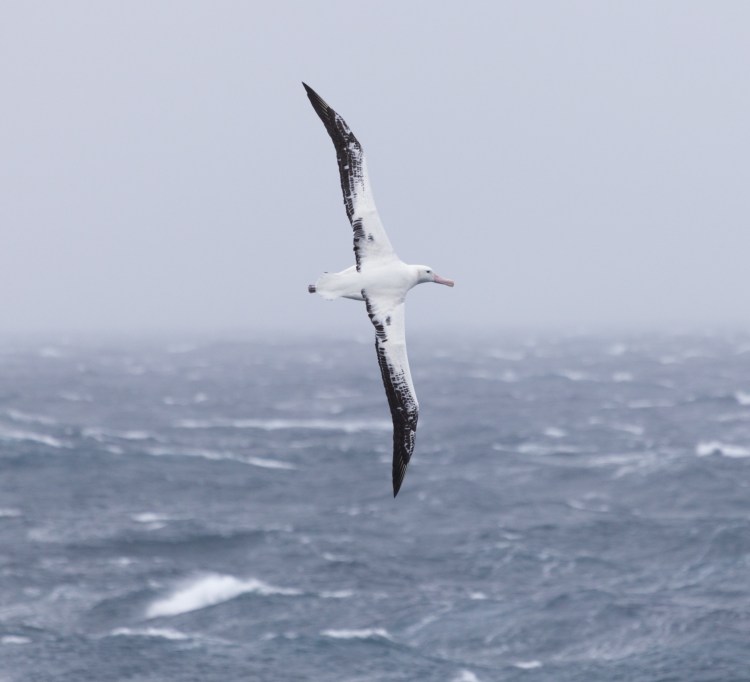
What thoughts can I leave you with, my human readers, that could be more powerful than Mr. Coleridge’s words? We Albatrosses have soared and survived over Earth’s most inhospitable oceans for millions of years; you humans have been part of our world for but a tiny fraction of this time, but now you are killing us in such mechanized and rapid fashion that we cannot recover. Every year 100,000 albatrosses are needlessly killed by fishing boats that fail to take simple, inexpensive precautions to avoid harming seabirds. Your scientists will tell you what we already know intuitively, that we have but a few decades remaining.
I leave you with two images, and the ancient mariner’s words:
He prayeth best, who loveth best
All things both great and small;
For the dear God who lovth us,
He made and loveth all.

And I had done a hellish thing,
And it would work ’em woe:
For all averred, I had killed the bird
That made the breeze to blow.
Ah wretch! said they, the bird to slay,
That made the breeze to blow!
 Haumanu Speaks/PoetiCalli