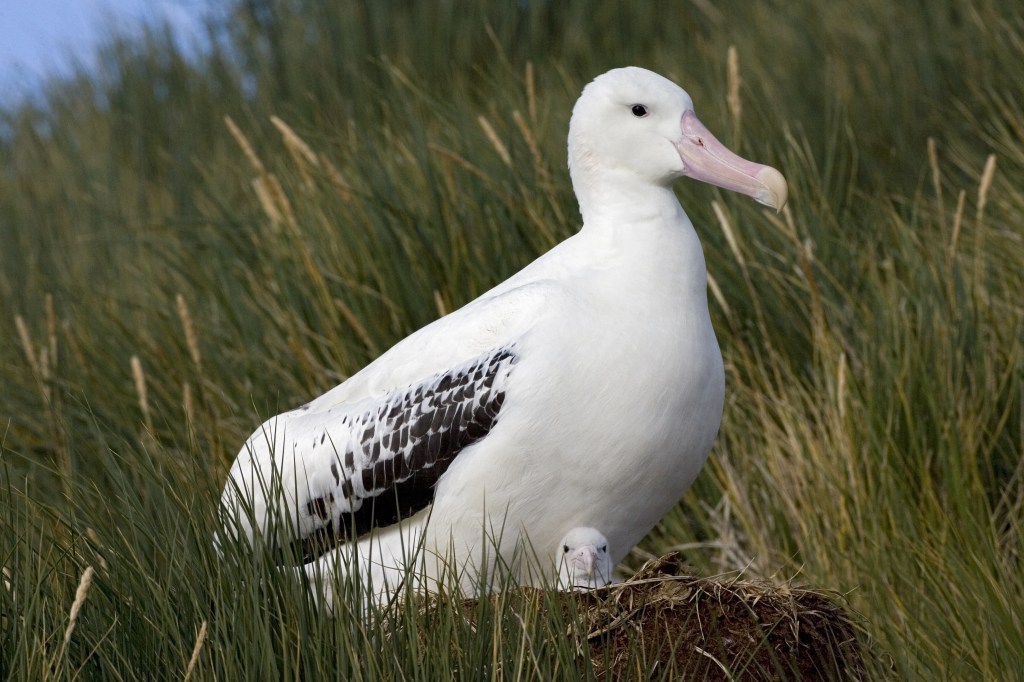
Today I want to introduce you to some of my albatross cousins who live at the equator, but first … My pride demands that I share an update from here on Bird Island in the south Atlantic. Ilupa and I have been working hard to keep our new chick Lukarri well fed and safe. Lukarri was very camera shy at first—you can barely see her peeking out from under Ilupa—but now she is a little more brave. She is also old enough that Ilupa and I have begun telling her some of the stories of our ancestor Tiyua the Wanderer. Lukarri is as enthralled by these tales as we were when we were young chicks.
So, things are going very well so far, but it will be almost six more months before Lukarri will be able to attempt her first flight.

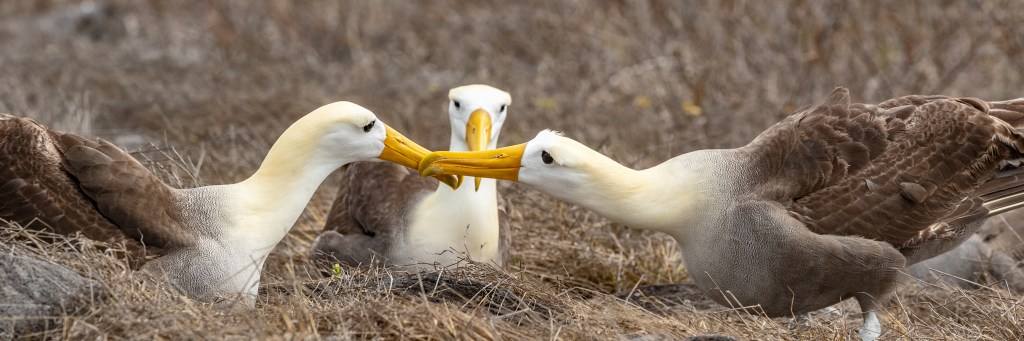
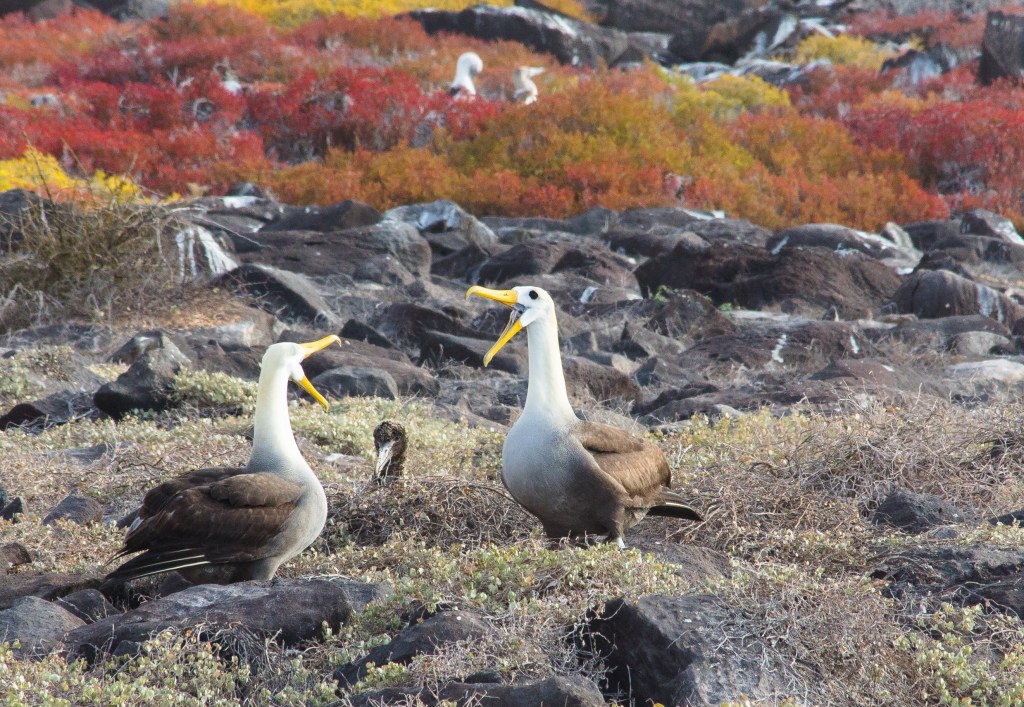
Now, let me introduce our cousins the Galapagos Marru (you must remember this is the name we albatrosses use for ourselves). Here three birds engage in ritualized dancing and display to woo a mate.
The Galapagos Albatrosses ( which you humans sometimes refer to as Waved Albatrosses) are the only one of Earth’s 22 albatross species to live at the equator. They are smaller than we Wanderers, with wing spans of ~8 feet compared to our ~12 feet. The Galapagos birds are about 31-35 inches from beak to tail, and have lovely bright yellow bills, in contrast to our pale pink bills.

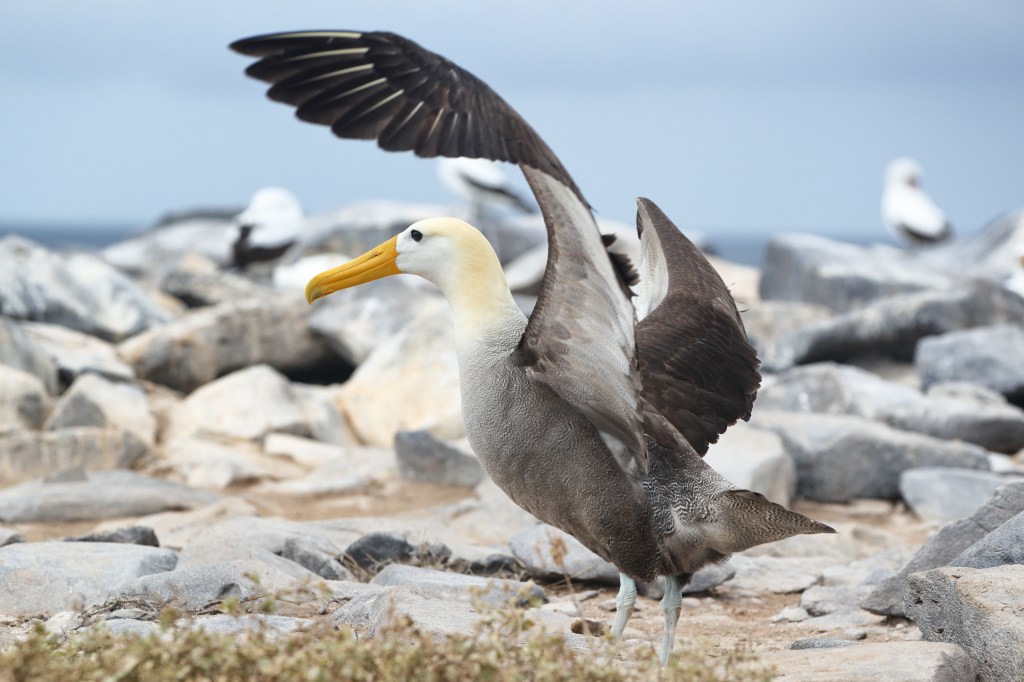
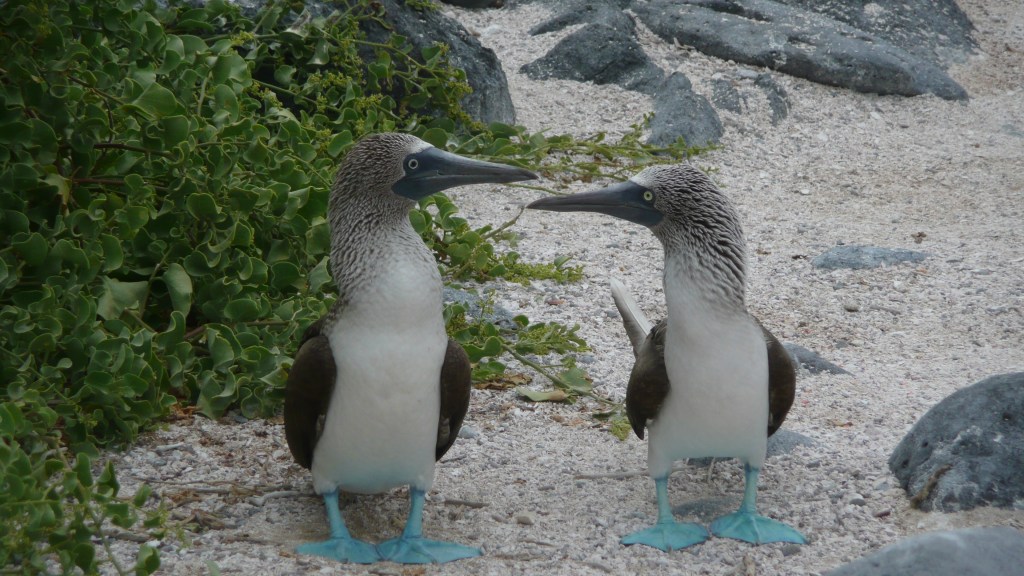
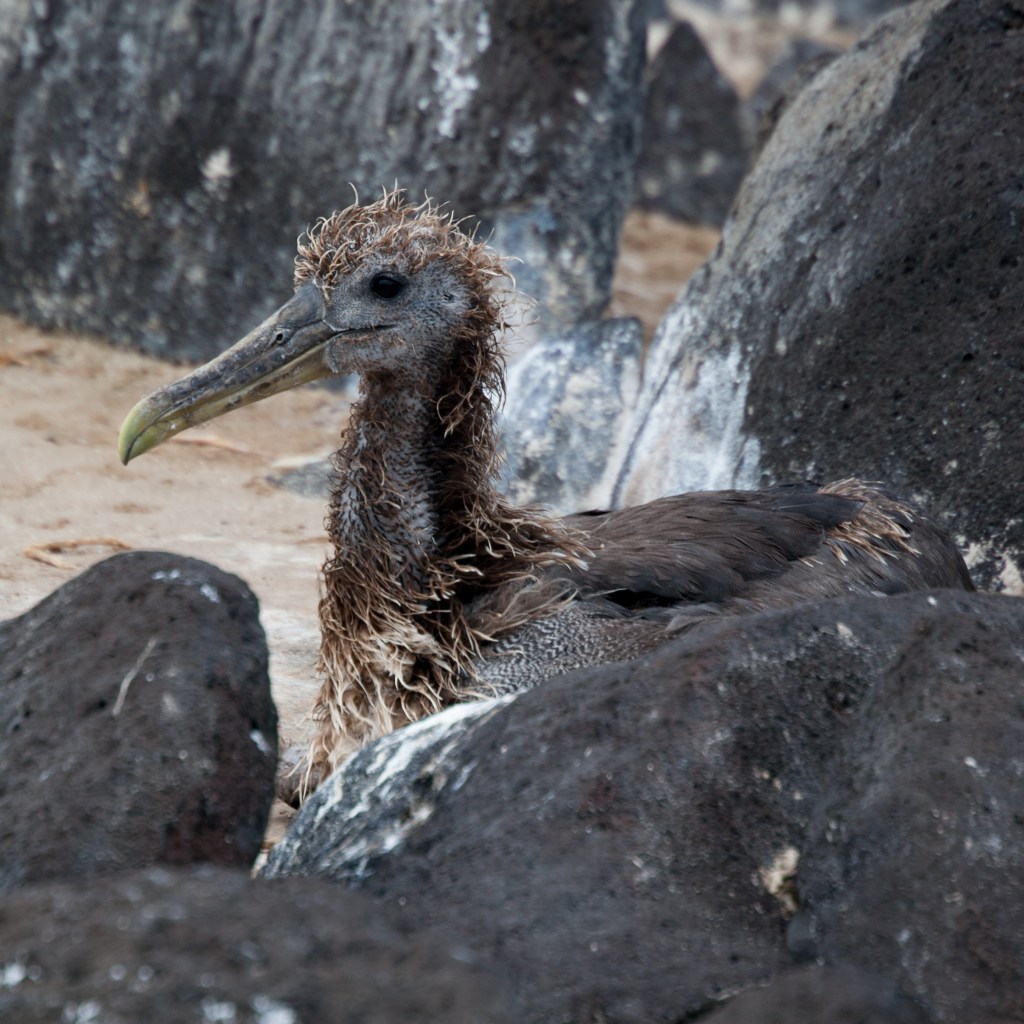
As their name implies, these Marru nest only in the Galapagos National Park, primarily on Espanola Island, where they share their nesting grounds with many exotic creatures, like Christmas Iguanas and Blue-footed Boobies (how did evolution ever come up with those dazzling blue feet?! Amazing!).
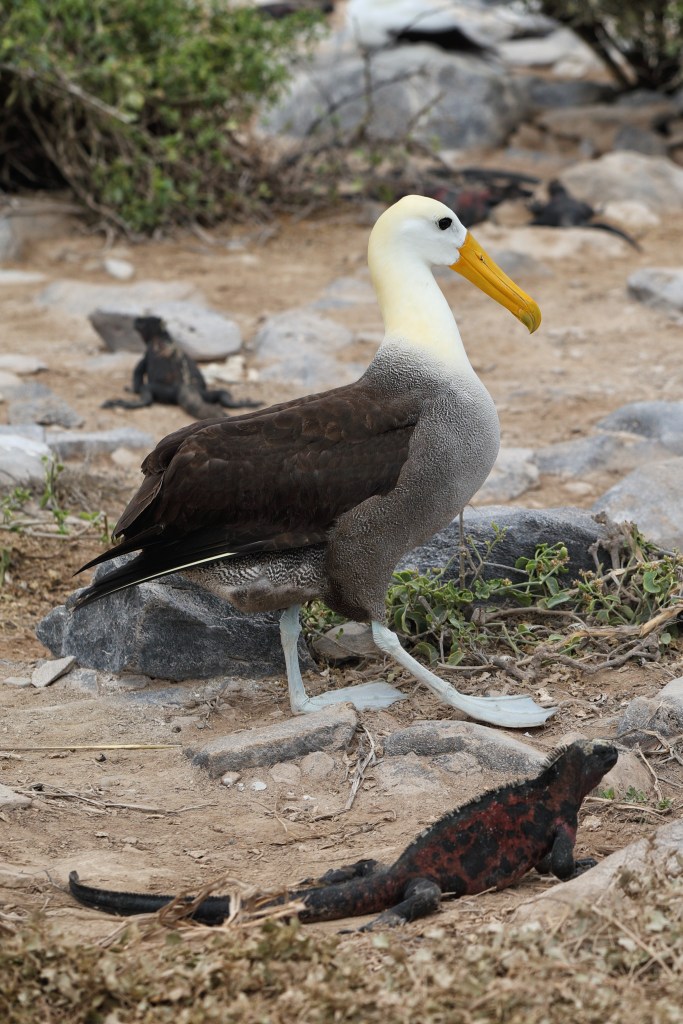
Like all albatrosses, the Galapagos birds love squid, and will sometimes forage at night when squid often come to the surface of the ocean. These Marru also eat fish and crustaceans. When foraging, they typically travel in a straight line between the Galapagos and the coasts of Peru and Ecuador, and herein lies the grave threat to their survival. Commercial fishing is restricted within the protected waters of the Galapagos National Park, but outside these waters long-line fishing boats take a heavy toll on seabirds. These boats put out lines 50-100 miles long with thousands of baited hooks. Some boats take precautions to make sure the bait doesn’t float on the surface, but most do not. There are many large boats that fish illegally in the waters outside the Galapagos National Park. These boats are criminal enterprises that often rely on human trafficking to obtain their crews.
Albatrosses attracted to the floating chunks of fish laid out by long-line boats are hooked and then drowned when the line is drawn in. Over 100,000 albatrosses are killed every year by long-line fishing, a devastating number for birds that mature and reproduce so slowly. It is known that with the Galapagos albatrosses more male birds are killed than females, leaving a skewed sex ratio in the surviving population.

There are currently ~12,000 breeding pairs of Galapagos albatrosses, about 70,000 birds in all. This may sound like a lot, but in 2007, after years of steady decline, these albatrosses were listed as critically endangered, highly at risk for a catastrophic extinction event. That is why they are one of the two featured species in this year’s World Albatross Day. So when you eat seafood, remember that there are many dimensions to “sustainable” fish. Try to remind yourself of the seabirds that need fish for their survival.
 Haumanu Speaks/PoetiCalli