The quote is from Mark Twain, in the voice of Huckleberry Finn. Having spent about three years editing my own manuscript, skimming through probably hundreds of literary agent profiles, and sending out a handful of query letters, I came to feel some of Huck Finn’s frustration.
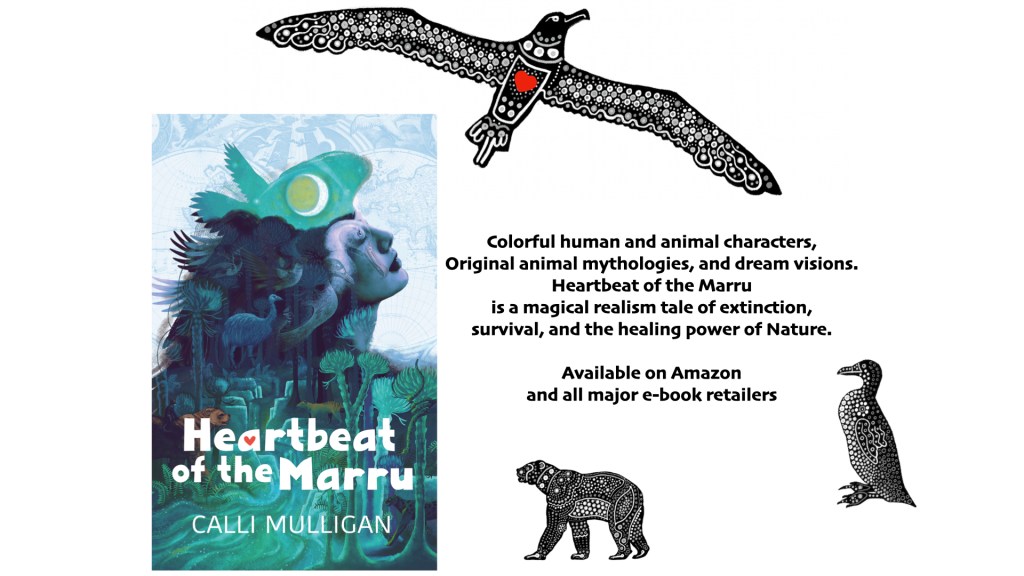
My novel Heartbeat of the Marru is a magical realism eco-mystery that explores our planet’s accelerating rate of extinction through the experiences of six young people and several animal characters who speak philosophically and at great length in the dreamtime. I didn’t write this book out of a conscious intention to “save the planet”; I wrote it because it was the story that came to me out of the unconscious, out of my longstanding interests in life.
I knew it wouldn’t be easy convincing a literary agent to take on a middle-aged first time novelist with minimal digital presence, but naive hope is a powerful force, and I felt excited as I sent out my first query letters. While I learned a great deal from the kabuki dance of querying, there was much not to like about the process, beginning with the one sentence pitch summary of one’s book. Given that agencies receive thousands of queries every year, this may be a necessary evil, but it is still a crass and, for me, insulting evil. My one experience with a “Twitter Pitch Party” was a complete waste of time. The comments of many others who participated that day made it clear I was not alone in my feelings. It was impossible not to think of Monty Python’s “All England Summarize Proust in 15’ or less Competition,” and to wonder if much of Tolstoy and Dickens—let alone Proust—would ever be published in today’s landscape.
As I researched literary agents I kept asking myself how Homer would pitch The Odyssey … “The seafaring adventures of a hero returning home from war?” How about Anna Karenina?“Young society mother finds true love outside marriage then lies down upon the train tracks.”
My second biggest beef with the query process is the no-response rejection. “Due to the very high volume of queries we cannot respond individually to each submission.” No, probably not, but how hard would it be to press one button on a keyboard and send out a timely robo-rejection? The Query Manager software does allow this, but most agencies do not as of yet use this software. My guess is that in the vast majority of cases the decision to reject is made within minutes. If an author submits a courteous and well written query, that letter deserves a response. Failing to provide writers with timely rejections is weak.

All of my first 6 queries were rejected. As an ex-scientist, I wondered if extinction—despite being an urgently topical subject—is too depressing to interest agents and publishers. I wondered if eco-fiction in general is not popular, if talking animals are problematic, if agents want debut novelists to be young and beautiful, or if I was simply spinning conspiracy theories.
One of these first 6 agents was my top choice, primarily because of her literary interests, but also because my intuition kept telling me that this woman was a very nice person. I think my intuition was right. Although it took several months to come, this agent was the only one to give a brief but seemingly personal reply with a criticism that was the nudge I needed to make some changes in my manuscript I’d already been thinking about.
After taking a few months to make the changes and delete 18,000 more words from my book, I sat down to send out 4 new queries, but within minutes I was overcome with intense physical anxiety. My hands were trembling as I tried to send off the letters. It simply didn’t feel exciting anymore, and I started asking myself if this was really what I wanted. I sent off my queries, but 2 days later I noticed myself thinking seriously about publishing independently with Amazon. I visited reedsy.com and saw the tremendous resources available to independent authors, but couldn’t quite get past my view of self-publishing as a depressing acceptance of defeat.

A few days later, however, I’d made my decision to self publish. How did this happen? Allow me to tell a story. When I was a teenager my mother came home from her grocery shop one day and told me that a friendly, 65-ish man had been coming by, mostly to chat with my mother. He’d lost an arm in the Korean War, and seemed lonely. That afternoon he’d startled my divorced mother by coming out and saying that he wanted to shack up with her. Beleaguered by years of illness and family stress, Mom was clearly bewildered and rather rattled by the forthright proposition. She politely declined the overture, but a few days later the man returned to the store carrying a thick stack of papers—the pages of a novel he’d previously written. He gave the manuscript to my mother as a gift, and asked for her impressions.
That night I read the first 2 pages of the novel. It was a “dark and stormy night” sort of romance, and may well have become a bodice ripper, but I only read the opening pages. It wasn’t very good. Mom and I laughed a little together, but her face still registered her quandary. What gentle words could she speak to this lonely old man who had tapped out his heart and soul on a typewriter with one hand?
Maybe literary agents come up against this dilemma every day. Maybe they try to shield themselves from the agony of these feelings with the no-response rejection. Maybe agents take occasional real abuse from disgruntled authors and have to protect themselves. Maybe they’re simply overwhelmed, and become inured to the feelings as doctors must quickly become accustomed to the ever present reality of death.

It all comes down to one question—why are there so many queries? We don’t know why the human psyche is so driven to create stories and myth, why we so desperately seek stories that move us emotionally. Whether you believe that this instinct has come entirely from molecular evolution or you also feel the presence of some transcendent mystery, the fact remains that the instinct is larger than ourselves. Following your creative imperative wherever it leads you, following it all the way to the end of that path, to the end of your novel, is a heroic quest. This instinct is the true magical realism, and it deserves to be treated with the greatest reverence. It’s easy to buy into (I did) the disdainful notion that self publishing platforms are cultural junk piles, but they aren’t. They are meeting a deep instinctual and, I would say, spiritual need in our society. Many excellent books are independently published, and many bad books are put out by mainstream publishing houses.
I do not, alas, remember my mother telling me what she said to the man in her store. We had to move shortly thereafter, Mom died a few months later, and the mysterious man with his manuscript became one of those brief, uncanny encounters that leave behind an emotional universe far out of proportion to the brevity of the moment. I have so often wondered why, amidst all the suffering of those years, this particular fragment of memory has stayed with me, surfacing sporadically to breath and to survey the seas of my psyche, its images unaltered by time, as if it were waiting for a moment it hoped or knew would one day come. Late last year, that moment finally came.

I gave conscious rationality several days to consider all the aspects of the decision to self-publish my book. Back and forth, back and forth my intellect went between the continued pursuit of a literary agent and the path of independent publishing. Then the unconscious spoke in an overpowering way—the memory of the old man and my mother rose up out of my psyche with the force of a breaching whale, grabbing me with an energy I hadn’t experienced before. For one magical morning I really felt my mother’s presence—I really felt like maybe she was finally understanding my introversion, like she was picking me up after I’d fallen and telling me that somehow everything would be alright with my book. Only after a few hours did I realize that this moment was occurring on the anniversary of my mother’s death, a day that had passed without much emotion for many years. I asked myself ‘Momma, are you here with me? Is this crazy?’ That morning sealed my decision to self-publish.
Perhaps a more talented writer than myself could adequately describe with words the feelings that accompany these rare moments of reverie, when something emerges from the unconscious with such force and somatic resonance that ordinary time and place recede, when hidden nuances of memory suddenly reveal themselves, when past and present coalesce into a clear path forward, when everything feels magical, transcendent, and alive. We remember what we need to remember from childhood, as from a dream. We remember the clues that can lead us to the best parts of ourselves and others, and to forgiving those who have hurt us.
I never met or even saw the old man—the picture my imagination painted of him was drawn entirely from my mother’s description and the emotions of the moment; I realize now that this picture is as much an image of my mother and myself. I see this lonely old man plugging away at his typewriter with only five fingers, and I see myself struggling to write my own novel through the prism of my dyslexia. The ideas, sentences, and paragraphs pile up inside my head far faster than I can ever get them into a computer. Finishing my novel has been a harder, slower road than for most writers. I’ll never be an every day blogger or a one book per year novelist. As accepting as I am of my reality, I also cannot describe in words the frustration of it.
It is ironic that the traditional avenue of entry into the world of publishing degraded my connection to the magic writing brings me. I never imagined the decision to be an independent author could feel so liberating. I exit traditional avenue with only one regret—that I didn’t end the process a few months earlier when it first began feeling oppressive and demeaning. I learned from the adventure of querying literary agents, and don’t think I would have edited my book as tightly had I not done all the research that went into querying. I’m grateful to the one kind agent who gave me a brief but personal response. I know I may never sell many copies of my novel; I know the risks. But I’m pretty sure Huckleberry Finn would applaud my decision, and that makes me smile.
My book Heartbeat of the Marru is available from many online retailers.
 Haumanu Speaks/PoetiCalli